Innovation on the Spot: The Green Village at TU Delft
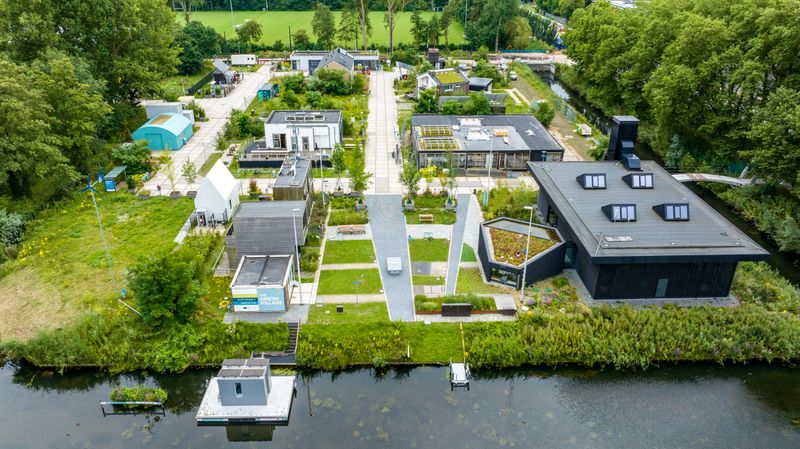
At TU Delft’s field lab, The Green Village, innovative solutions for climate adaptation in public spaces are tested and further developed. Lindsey Schwidder, Project Manager for Water and Climate Adaptation at the university, discusses the impact of this practice-based place on campus for knowledge and calls on municipalities: “Come visit us to observe, learn, and share your experiences.”
Climate adaptation has now become firmly embedded in municipal policy. Capturing rainwater, increasing green space, and other measures to mitigate the effects of intense rainfall have become the norm rather than the exception. Yet the urgency continues to grow, Schwidder says. “Beyond water nuisance, issues like heat stress, drought, and extreme weather demand increasing attention. The tasks for municipalities are expanding, and the pace really needs to pick up. That’s where we can help.”
Schwidder is affiliated with The Green Village, the testing ground for sustainable innovations on the TU Delft campus. Here, she works on the practical application of solutions in public spaces, together with students, researchers, companies, and, above all, municipalities. “We’re not just an inspiring meeting venue—we’re a place where you can actually see, try, and experience things,” Schwidder explains. “Every week, we welcome civil servants from across the Netherlands who want to witness firsthand which solutions really work.”
From Urgency to Implementation
That climate adaptation has now become a standard part of area development is, according to Schwidder, “a major step forward.” “A few years ago, everything revolved around water: capturing rain, preventing nuisance. Great progress has been made there. What once sounded like something for the future is now a serious solution on designers’ and engineers’ drawing boards.”
Still, awareness is growing that more is needed. “You can see that the impact of heat stress and drought is increasing. Newly planted trees are still young, so they don’t provide much shade yet, and underground, there isn’t always enough room for planting or water storage. Municipalities want to work adaptively to the climate, but sometimes struggle with implementation. Managers and policymakers don’t always have the same information or options. And projects take time. Working carefully is important, but the climate won’t wait.”
According to Schwidder, this is where institutions such as TU Delft and the Rotterdam University of Applied Sciences can play a role. “We’re not only here for students or researchers. We want to support municipalities in making the right choices. That’s why we have The Green Village: a real testing ground where solutions become tangible. Think of smart water buffers, heat-resistant paving, or techniques to make better use of the subsurface.”
Learning With and From Each Other
Schwidder notices that many municipalities are in the same phase. “They’re searching, experimenting, and achieving great successes. But too often, that knowledge stays within their own microcosmos. We see how valuable it is when managers from different cities meet and share experiences—especially when it comes to operations and maintenance, where there is a huge amount of practical expertise that is often underestimated.” An example? Schwidder: “We meet people here who maintain public spaces every day. They bring a wealth of insights about what works in practice. That knowledge is incredibly valuable but often remains in individuals' heads. We would love to see it shared more widely.”
She also observes a striking difference between large and small municipalities. “In smaller municipalities, sometimes only three people work on climate adaptation. The decision-making lines are short, which makes it easier to try new things. Larger municipalities have more people and resources, but are also more formal. These municipalities can learn a great deal from each other—if they manage to connect.”
A Call to Municipalities
The Green Village, therefore, opens its doors to municipalities looking to learn, test, or collaborate. “We’ve noticed that policymakers and innovation managers know how to find us,” Schwidder says. “But I especially want to invite other colleagues as well—legal staff, operations managers, and financial departments. They also play a key role in the success of climate-adaptive solutions. Come visit together and talk about what is possible.”
Her message is clear: municipalities don’t need to figure everything out on their own. “A lot has already been tested; a lot of knowledge is available. We’re happy to help unlock it. Visit us, ask your questions, get inspired. We’re a knowledge partner ready to think along—not from an ivory tower, but from right in the middle of real-world practice.”
Fact box
1. Over the past four years, more than 100 municipalities have visited the field lab for a tour or in-depth dialogue session. Most of these came from the province of Zuid-Holland (46).
2. Innovations tested at The Green Village have been scaled up in nearly 180 municipalities across the Netherlands. More than half of all Dutch municipalities now use innovative solutions.
3. Municipalities can make a significant impact in their own work areas: in major cities, the share of public space under municipal management ranges from 40 percent (Rotterdam) to 80 percent (Amsterdam), and in smaller towns or villages, it is well above 50 percent.